Low
Mid
High
Note: written in treble clef
How to Finger low A on the Clarinet
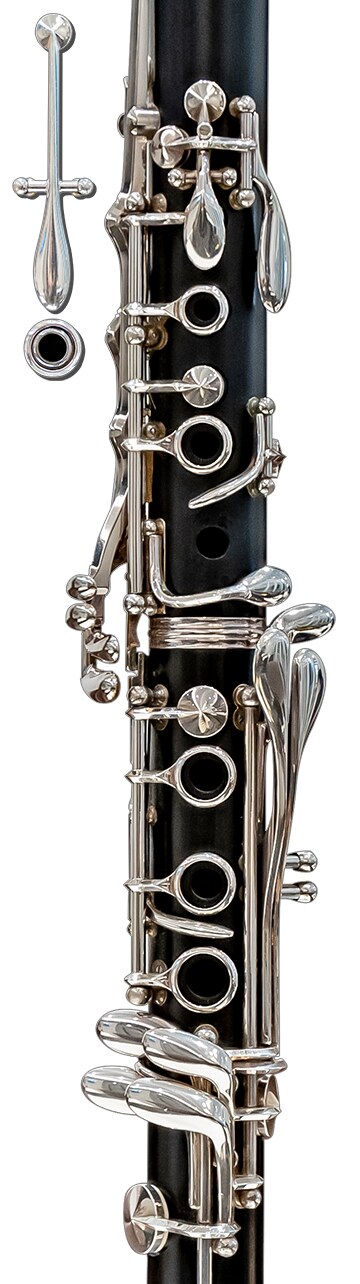
The fingering for low A covers six tone holes, from the left thumb down to the right middle finger.
Where to keep your ring finger so it moves efficiently
The right ring finger, busy on the lowest notes, isn't used from A upward, so how you hold it up decides whether you can move smoothly to other notes.
Keep the raised right ring finger waiting directly over its tone hole, about 7 mm to 1 cm (roughly a quarter to three-eighths of an inch) above it.
If you keep it at that height and in that spot, it can move efficiently and smoothly the next time it has to cover the hole.
On the other hand, bringing the finger too close to the hole in an effort to move as little as possible isn't good either.
On the clarinet the pitch changes as air escapes from the open holes, so a finger that hovers too close blocks the air's path, and that makes the tone muffled or lets the pitch sag.
Lifting your fingers so they return easily
When you lift your fingers one after another, the trick is to bring each one to the height of the first finger you lifted.
Suppose you lift the pinky and then the ring finger, starting from low F.
When only the pinky is up, it naturally sits higher than the ring finger.
But if you keep that same gap between the two when you lift the ring finger next, the pinky ends up nearly twice as high as it started.
Which means that if you go on to lift the middle finger with the same spacing, the pinky ends up very high indeed.
A finger that has risen too high tends to come back with a rush when it's needed (“I have to get back quickly!”).
Needless tension creeps in and the notes no longer connect smoothly; the fingers land at different times and slip out of position more easily. Nothing good comes of it.
If you can bring the other fingers to the height of the pinky you lifted first, every finger stays close to its own hole, ready to cover or uncover it quickly.
That said, be careful: if you think so hard about matching the heights that you hold your fingers down by force, it backfires.
Keeping the ring finger on target when you return to G
When you go back from low A to G, check that your right ring finger is covering its hole without slipping off.
If the ring finger is out of place and leaves a gap, air leaks out and the note won't sound properly.
First, make sure the ring finger is directly over the hole.
Then, because trying too hard to “cover it firmly” brings tension that pulls the finger toward the middle finger, it's important to move it as if you were just lightly raising and lowering it.
How to check your finger positions
Between notes in your long tones, for instance, try putting down the fingering for low E; it lets you check whether the fingers you aren't using have stayed in the right place.
Make this check a habit and your fingers will settle into good positions on their own, and they'll move smoothly in pieces as well.
If you use a mirror, start by watching as you put your fingers down to get the right feel.
Once you're used to it, set your fingers first and then check in the mirror whether you got it right; little by little your fingers will learn the good positions.
So that your fingers move efficiently when you play pieces, build in the correct finger positions during long tones, when the fingers don't have to move.
Learning it as a set with middle-register E
Keep the low A fingering and press the register key, and you get E in the middle register.
Make a point of learning these two notes as a pair.
When you switch to the upper note with the register key, you must keep playing with the same embouchure (the shape of your mouth) and the same air flow as on the low note.
Be careful not to tighten your mouth or blow harder at the moment the note changes.
Using your ring finger with ease
If the lifted ring finger waits about 7 mm to 1 cm above its hole, level with the pinky, your fingers move smoothly and stay on their holes when you return to low G.
For fast finger work, where the unused fingers are actually matters more than the ones pressing down.
But even when you understand the ideal position in your head, it takes a little time for your body to get used to it.
Keep it in mind from your daily long tones, and take your time building good positions.