Low
Mid
High
Note: written in treble clef
How to Finger low G on the Clarinet
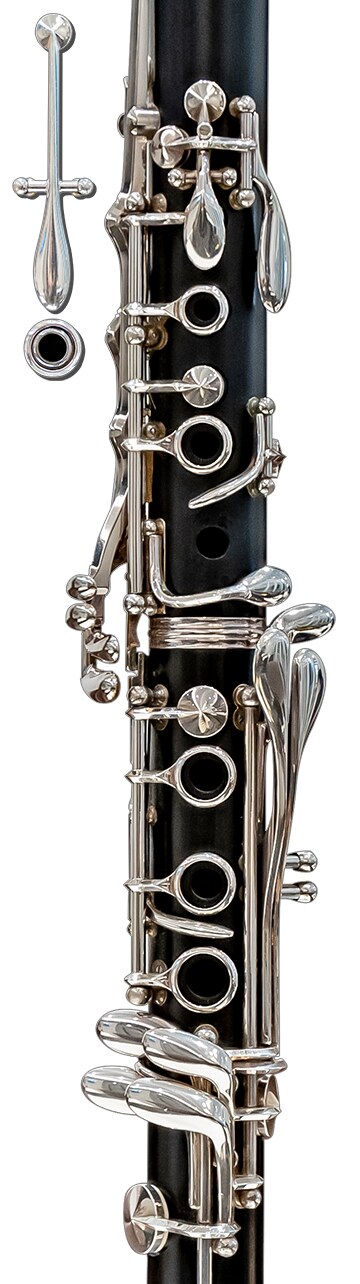
The fingering for low G covers all seven tone holes, from the left thumb down to the right ring finger.
Why low G can feel hard to sound
When low G won't come out properly, the main culprit is the hole under your right ring finger.
It is the largest of the holes you cover directly with a finger, and the farthest away, yet it's assigned to the ring finger, the weakest and hardest to control of the five.
With even a little tension the finger drifts toward the middle finger, a gap opens, and the note stops sounding.
If your finger is touching the slim key just above the ring finger, it's no exaggeration to say it has slipped, 100% of the time. (If your hands are very large or your fingers thick, you may touch it naturally, but that's quite rare.)
When the note keeps failing, it's easy to decide that “low G is a hard note,” but nothing in the way the clarinet is built makes it difficult to sound.
Keeping your right ring finger from slipping
The number one reason the right ring finger slips is the tension that comes from trying to “cover the hole firmly.”
This note also uses every tone hole in the right hand, so you tend to end up gripping the instrument, and that is another big cause.
If your hands are small or your fingers slim, take extra care: even the slightest shift or tilt of a finger affects the sound.
Rather than “pressing down on the hole,” think of “closing the hole with the pad of your finger,” and practice patiently and carefully.
If you find yourself wondering, “F sounds fine, so why won't the G right before it?”, the answer actually lies in your pinky.
The pinky and ring finger tend to move together, so when you reach to press a key with the pinky, the ring finger gets pulled down a little and settles into a good position.
When you're working hard to get G out, your pinky has probably crowded up against the ring finger, or shot out straight, and strayed far from its place over its four keys.
Keeping the pinky where it lightly touches the F key can make G easier to sound, so try it if this sounds familiar.
How to reset when the note stops sounding
As the notes get lower and more fingers come down, the right hand's job inevitably starts to feel less like “covering holes” and more like “holding the instrument,” and you tend to clench it without realizing.
Gripping makes the fingers slip.
And tension in the fingertips naturally spreads to the hand and arm until your whole body stiffens, your breathing turns shallow, and it gets hard to send out a full stream of air.
If the note isn't sounding well, take the instrument out of your mouth for a moment and reset your posture.
Let both arms hang loose (keep your back long; don't let your whole body slump), or say “ahh” out loud with your arms still down, and notice what it feels like to breathe out with your body relaxed.
Keep that feeling in mind and play low G again; you should feel the air go in smoothly and the tone come out full.
Keeping your left thumb from lifting
Add the register key to the low G fingering and you get D in the middle register.
For this, rest your left thumb at a slight angle to the body of the instrument, with the tip touching the register key.
Don't stand the thumb up on its tip to press the register key.
Keep the shape that covers the hole and think of tilting the thumb slightly up and to the left; that way the pad doesn't lift and open a gap, and you can move to the upper note cleanly.
Playing low G with ease
As you come down from the upper notes, tension in your body starts to deaden the sound, especially from around G.
So the first step toward a steady G is not to strain for a big sound (straining stops your air) and not to clamp your fingers down to keep them from slipping.
If you brace yourself thinking “this note is hard,” extra tension creeps in, the air stops flowing freely, the right ring finger slips, and the note gets harder and harder to produce.
Don't overthink it; little by little, get the feel of sounding it in a loose, natural state.