Low
Mid
High
Note: written in treble clef
How to Finger low E on the Clarinet
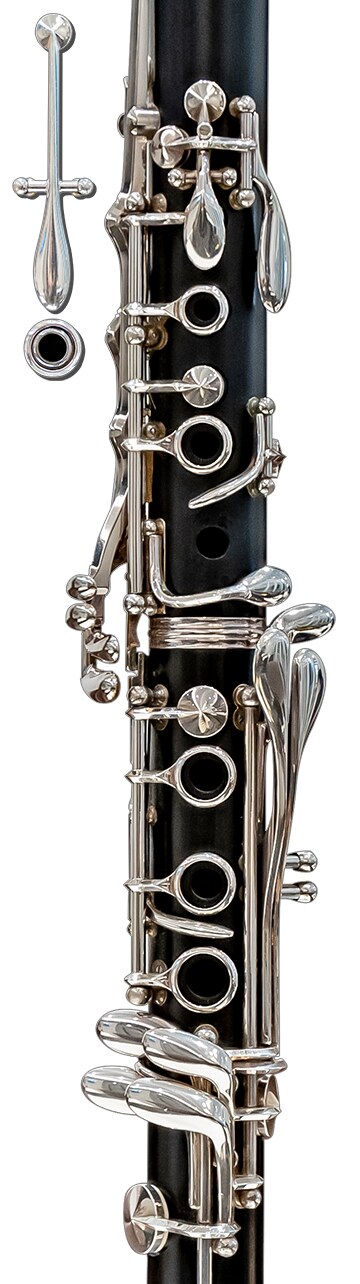
The basic fingering for low E covers all seven tone holes, from the left thumb down to the right ring finger, with the left pinky on the E/B key and the right pinky on the F/C key.
Tips for pressing the E/B key
Place your left pinky at a slight angle and hook the tip lightly over the outer edge of the key.
You don't need to push hard; a light touch is enough to bring the key all the way down.
Be careful not to reach your pinky straight toward the center of the clarinet.
A stretched-out pinky easily brushes the neighboring F♯/C♯ key, which can keep the note from sounding.
What to check when it won't sound
If the note won't come out, first check whether any left-hand fingers have slipped off their holes.
The finger that slips most often is the left middle finger.
The right ring finger's hole is large, so that finger tends to slip as well.
Also, just because this is the lowest note doesn't mean you should loosen your embouchure (the shape of your mouth).
Keep your usual embouchure and send plenty of air straight into the instrument.
Alternating your left and right pinkies
The E/B key can be pressed with either pinky, so in passages with several pinky notes in a row, the basic rule is to alternate left and right.
For example, in E → F♯ → G♯, low G♯ only has a key on the right side.
So work backward from G♯, which has no alternate fingering: take F♯ with the left pinky and E with the right, always alternating.
Unless you run into a rare case, such as several notes in a row with no alternate fingering, don't use the same pinky twice in a row or slide it from key to key. (That's exactly why the clarinet has so many keys.)
When going from E to F♯ or from F♯ to E, you can play E with either the right or the left pinky.
Pick whichever finger and fingering are easiest to move.
You might decide “E is always on the left,” or “whichever note comes first goes on the right.” Having your own simple rule is the secret to smooth finger work.
Learn it together with middle-register B
Add the register key to the low E fingering and you get B in the middle register.
Low E, F and F♯ use the same fingerings as middle-register B, C and C♯, so once you have the low fingerings down, they carry straight over to the middle register.
Low E's tuning tendency
Low E tends to sit flat.
Especially when you play loudly with a strong air stream, your mouth can loosen, which makes it go even flatter.
How far a note drifts differs from instrument to instrument, so use a tuner regularly to learn your own clarinet's tendencies.
Playing low E with ease
The key to playing low E without strain is not to force your pinky to stretch for the key, but to relax and gently hook your fingertip on it.
With no extra tension in your pinky, the rest of your hand keeps its shape, and you can keep the tone holes fully covered as you play.
Starting with your daily long tones, pay attention to the angle and lightness of your pinky, and get comfortable using either the left or the right key.
Also, because every finger is in use on this note, it's easy to grip the instrument without noticing, stop your air and get no sound at all (and surprisingly, you can't tell your air has stopped).
So don't psych yourself up to “make it sound!”; just relax and play.